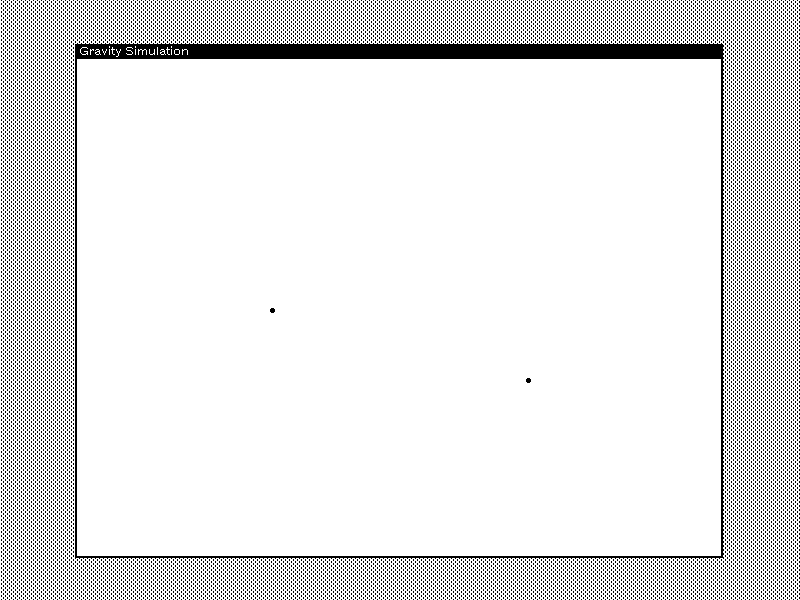
I started working on GravityLoops, a software that simulates a collection of bodies interacting under the mutual gravity. I develop it on Medley in Interlisp and its object extension LOOPS, the Lisp Object-Oriented Programming System.
GravityLoops will show an animation of the bodies and their motions, along with facilities for defining the parameters of the system and controlling the simulation.
Motivation
I've been meaning to do a LOOPS learning project but none of the ideas I initially came up with clicked.
I wanted something more complex than a toy but easy enough to implement with reasonable effort. The project should also incorporate naturally the features of LOOPS, such as the gauges library of graphical meters and dials for displaying quantities.
I finally stumbled upon the gravity simulator described in the article Force-Based Simulations by Todd King in the September, 1989 issue of Dr. Dobbs Journal. It's just perfect.
I'm adapting to LOOPS the design of the sample C++ code that comes with the article. It's nice as it reads like an object-oriented domain specific language for simulation. The code is so short and clean I can fully understand it despite my minimal C++. I never thought I would say that of C++.
There is much to like of King's program starting from its domain, astronomy and physics, which overlaps with some of my passions.
The project is period accurate too as when Dr. Dobb's Journal published the article LOOPS was still under development. And, along with window systems, simulation was among the killer applications object-oriented programming proponents pointed to.
The program comprises only two, hierarchically unrelated classes, a shallow inheritance design more in line with the later evolution of object-oriented programming. But the application does offer other potential classes that are a good fit for LOOPS. For example, I plan to specialize the LOOPS class Window to represent the simulaton window. I will likely need more classes for the GUI, such as dialogs for entering the simulation parameters.
LOOPS is one of the subsystems best integrated with the Interlisp environment and comes with good documentation. I want to experience this high integration, the ability of combining tools designed to work together that comes natural once you're familiar with the environment.
Adapting King's program to the Interlisp environment is also an opportunity to employ useful programming techniques like screen buffering to improve animation fluidity. Plus, anything that draws pretty graphics is fun.
Design
To adapt Todd's design to LOOPS I create matching classes with similar instance variables and methods, named according to the LOOPS style. I will rename a few confusing methods, such as UNIVERSE::service() to register a body with a universe which I'll call Universe.Register, and UNIVERSE::big_bang() to run the simulation which will become Universe.Simulate.
The C++ code represents a 2D vector as a struct that I map to an Interlisp record. A class seems overkill.
Todd's program outputs to the MS-DOS text console via the conio library. GravityLoops instead will draw graphics in a window.
So far the code implements the Body class that represents a body. I'm about to start working on the Universe class that holds a collection of bodies and manages the parameters and state of the simulation.
Once the core classes are in place I will turn to implementing the animated simulation.
#GravityLoops #Interlisp #Lisp
Discuss...
Email | Reply @amoroso@oldbytes.space